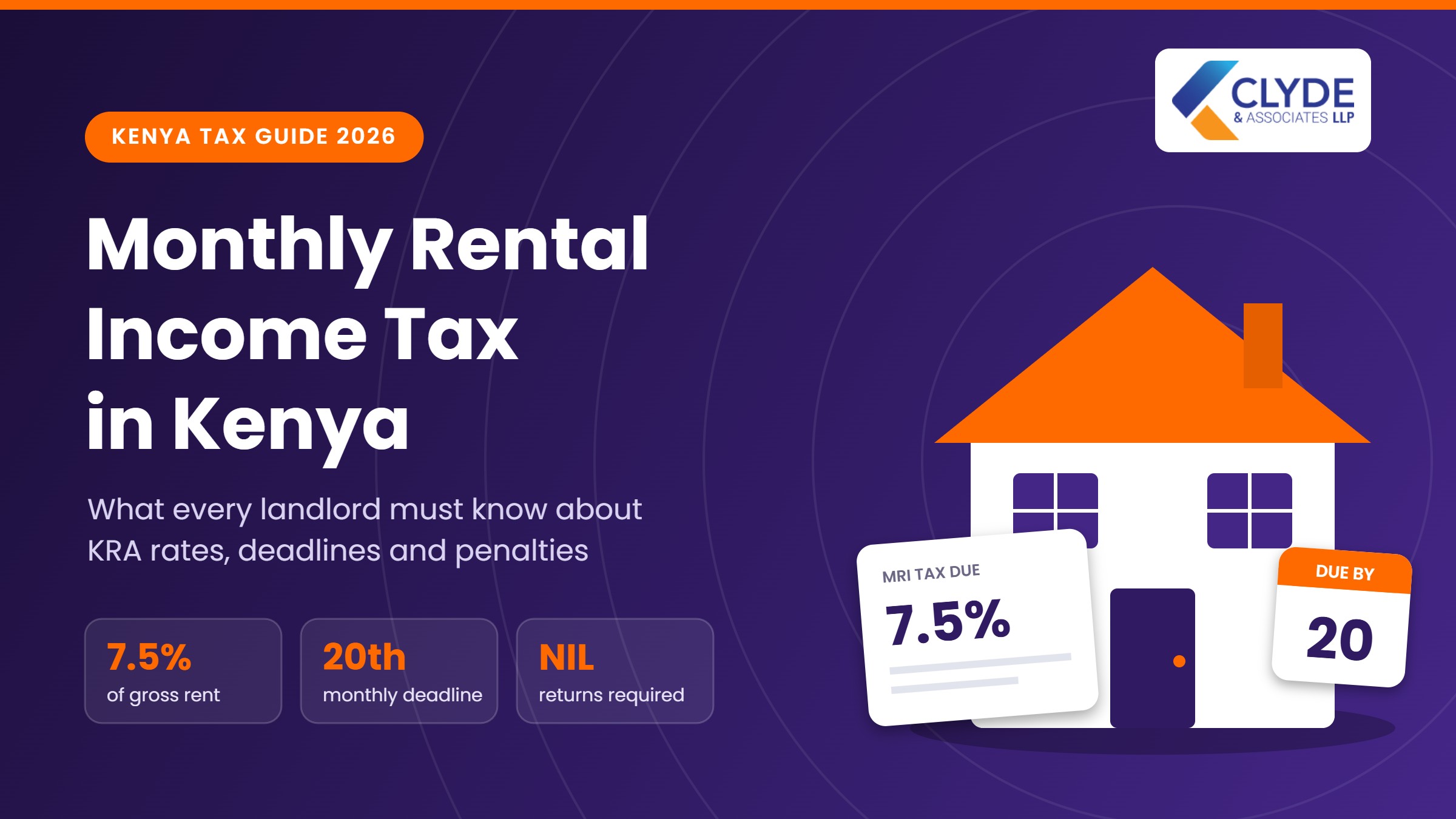
Are you earning rental income every month? If so, you may be required to pay monthly rental income tax in Kenya to the Kenya Revenue Authority (KRA).
Many landlords collect rent for years without knowing they have a monthly tax obligation. KRA is now using digital tools to find undeclared rental income, so understanding the rules has never been more important. This guide explains who pays, how much, when to file and how to avoid penalties.
What is Monthly Rental Income (MRI) tax?
Monthly Rental Income (MRI) tax is a simplified tax on rent earned from residential property in Kenya. It is a final tax, which means that once you pay it, you do not pay any further income tax on that rent.
MRI applies to resident persons. This includes individuals, partnerships and companies that earn rent from residential houses, apartments or other homes let out for people to live in.
Who qualifies for the MRI regime?
You fall under the MRI regime if your annual residential rental income is more than Ksh 288,000 but does not exceed Ksh 15 million. In monthly terms, that is more than Ksh 24,000 and up to Ksh 1.25 million in rent.
| Annual residential rent | How it is taxed |
|---|---|
| Ksh 288,000 or less | Outside the MRI regime |
| Above Ksh 288,000 up to Ksh 15 million | Monthly Rental Income tax at 7.5% of gross rent |
| Above Ksh 15 million | Declared in the annual income tax return together with other income |
If your rent is expected to go above Ksh 15 million in a year, you should notify KRA before the end of that year. Non-resident landlords are not covered by MRI.
How much is monthly rental income tax in Kenya?
The tax is charged at 7.5% of gross residential rent. The rate was reduced from 10% to 7.5% with effect from 1 January 2024.
Gross rent means the full rent you actually received in the month. You do not deduct expenses such as repairs, caretaker salaries, land rates, mortgage interest or agent fees before calculating the tax.
How to calculate your MRI tax: a simple example
Suppose you own a block of six apartments in Kasarani. Each unit pays Ksh 15,000 a month, and all tenants paid in October.
- Gross rent received in October: 6 × Ksh 15,000 = Ksh 90,000
- MRI tax: 7.5% × Ksh 90,000 = Ksh 6,750
- Due date: on or before 20 November
If only five tenants paid, the tax is based on the Ksh 75,000 actually received, which gives Ksh 5,625. The tax follows rent received, not rent that was due.
When is monthly rental income tax due?
MRI must be declared and paid on or before the 20th day of the month after the rent was received. For example, rent received in January is declared and paid by 20 February.
If the 20th falls on a weekend or public holiday, file early to be safe rather than waiting for the last day.
Do you need to file a NIL return?
Yes. If you received no rent in a month, for example because your units were vacant, you must still file a NIL monthly rental income return. A missed NIL return counts as a missed filing and can attract a penalty.
How to file and pay MRI
Landlords can file and pay through KRA’s iTax portal or the Electronic Rental Income Tax System (eRITS), which KRA launched in 2025 to make rental tax compliance easier.
- Register your rental property on iTax or eRITS, which is also reachable through eCitizen.
- Each month, enter the gross rent received for each property and submit the return.
- Generate a payment slip and pay through M-Pesa, a partner bank or the government paybill.
- Keep your payment receipts and tenant records in case KRA asks for them.
Property managers and agents can also be appointed to deduct the 7.5% tax from rent and remit it to KRA on the landlord’s behalf.
Watch this short video for more on monthly rental income tax in Kenya:
View this post on Instagram
What are the penalties for late filing and payment?
Failure to meet your tax obligations on time attracts penalties and interest. Because MRI is monthly, these charges can build up quickly.
| Offence | Individuals | Companies |
|---|---|---|
| Late filing of MRI return | Ksh 2,000 or 5% of tax due, whichever is higher | Ksh 20,000 or 5% of tax due, whichever is higher |
| Late payment | 5% of tax due | 5% of tax due |
| Late payment interest | 1% per month or part of a month on unpaid tax | 1% per month or part of a month on unpaid tax |
How is commercial rental income taxed?
Commercial rental income is treated differently. Rent from shops, offices, warehouses and other business premises does not fall under the 7.5% MRI regime.
Commercial rent is declared in your annual income tax return. Allowable expenses can be deducted, and the profit is taxed at your normal income tax rate. Some tenants are also required to withhold tax on commercial rent and remit it to KRA.
Can you opt out of MRI?
Yes. A landlord who qualifies for MRI can choose, in writing to the KRA Commissioner, to be taxed under the annual income tax regime instead. This may suit landlords with high expenses, because the annual regime allows deductions while MRI does not.
The right choice depends on your costs and other income, so it is worth getting professional advice before you opt out.
Important tax details at a glance
- The applicable rate is 7.5% of gross residential rent.
- The tax applies to annual residential rent above Ksh 288,000 and up to Ksh 15 million.
- No expenses are deducted before calculating the tax.
- Returns and payments are due by the 20th day of the following month.
- A NIL return is required for months when no rent is received.
- Commercial rental income is treated differently and is declared annually.
- Late filing and late payment attract penalties and interest.
Frequently asked questions
What is the monthly rental income tax rate in Kenya?
The rate is 7.5% of gross residential rent received in the month. It has applied since 1 January 2024, when it was reduced from 10%.
Who should pay monthly rental income tax?
Resident individuals, partnerships and companies whose annual residential rent is above Ksh 288,000 and up to Ksh 15 million.
Can I deduct expenses from my rental income?
No. MRI is charged on gross rent, so repairs, rates, agent fees and loan interest are not deducted. If you want to claim expenses, you can opt into the annual income tax regime instead.
When is the deadline for filing MRI?
On or before the 20th day of the month after the rent was received.
What happens if my house is vacant for a month?
You must file a NIL return for that month. Failing to do so can attract a late filing penalty.
Does MRI apply to shops and offices?
No. Commercial rental income is declared in your annual income tax return and taxed at normal rates after allowable expenses.
Where do I file and pay rental income tax?
On KRA’s iTax portal or the eRITS platform. Payment can be made through M-Pesa or a partner bank using the payment slip.
Related reading
- Kenya tax changes 2026: what every SME needs to know
- Withholding tax in Kenya: rates, exemptions and iTax filing
- Tax health check: how to avoid costly KRA penalties
Get help with your rental income tax
Monthly rental income tax in Kenya is simple once you know the rules: pay 7.5% of the gross rent you receive, by the 20th of the following month, and file a NIL return when no rent comes in. Staying on schedule protects you from penalties and interest that can quickly add up.
If your situation is more complex, such as mixed residential and commercial property or rent close to the Ksh 15 million limit, Clyde & Associates LLP can help. Our tax advisory team supports landlords with MRI registration, monthly filing and choosing the right tax regime. Contact us today to speak to a tax adviser.
This article is for general information and is not tax or legal advice. Rates and thresholds are correct as of November 2026; source: Kenya Revenue Authority.